Always and Forever SVG
A Designer’s First Glance: Romantic, Clean, and Ready for Real Fabric
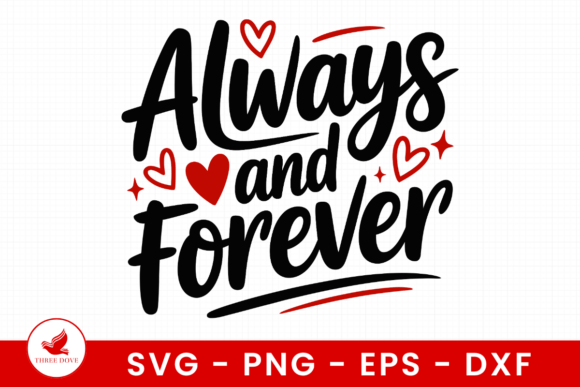
When I opened the Always and Forever SVG file—part of a Valentine’s Day digital collection—I didn’t see just another heart-and-script combo. I saw balance: soft curves in the script, a centered heart that breathes without crowding, and generous negative space around the phrase. It’s not fussy. No extra flourishes, no overlapping layers, no hidden micro-details that vanish under thread. That simplicity is its strength—and its first real test.
What This Design *Actually* Wants to Be Embroidered On
Last week, I prepped a batch of linen tea towels for a local boutique’s Valentine’s launch. I pulled up Always and Forever SVG as a candidate for the front corner—small, meaningful, and easy to stitch cleanly on a 4” hoop. It worked beautifully: the script held clarity at 3.5”, the heart stayed round (no distortion), and the overall shape translated directly into satin-stitched lettering with a smooth fill-stitched heart. No re-drawing. No digitizing cleanup. That’s rare for a design marketed as a T-Shirt Design but built with embroidery logic.
It’s equally at home on baby onesies (paired with light stabilizer and low-density fill), cotton tote bags (where the clean lines read clearly from 6 feet away), or unstructured aprons where dense stitching would stiffen the fabric too much. I’ve also used it as a subtle chest embroidery on lightweight sweatshirts—just 2.75” tall—and customers consistently comment on how “handmade but polished” it looks. Not crafty-cute. Not corporate-flat. Just warm, intentional, and quietly confident.
Where It Shines—and Where You’ll Need to Pause
Always and Forever SVG performs best on stable, medium-weight fabrics: quilting cotton, twill, midweight knits, and linen blends. On stretchy t-shirts? Yes—but only with cutaway stabilizer underneath and a slow-stitch setting to prevent puckering. On dark fabric? The contrast works well if you choose a thread with brightness—cream or blush instead of stark white, for example. On textured surfaces like bouclé or heavy terry? Scale it up slightly (4” minimum) so the letterforms don’t get lost in the pile.
It’s not ideal for curved caps or tight-knit beanies unless resized and re-hooped carefully—the script’s slight slant can distort near the bill seam. And while the heart is simple, avoid shrinking it below 1.5”: the inner curve starts to lose definition in satin stitch, especially with matte thread. For patches or iron-ons, this design holds up well—but confirm your applique software handles the SVG-to-embroidery conversion cleanly before mass production.
Real Impact on Your Craft Business
As an Etsy seller who ships 80+ personalized embroidered items monthly, I pay attention to how designs affect perceived value. Always and Forever SVG reads as thoughtful—not generic. When stitched on a kitchen towel gifted for an anniversary, it feels personal. On a baby blanket? Tender, not trite. That emotional resonance translates directly to customer trust and repeat orders. Buyers don’t ask, “Is this machine-made?” They say, “This feels made *for* someone.” That’s the quiet power of a well-proportioned, uncluttered embroidery file.
For small shop owners building cohesive branding, this design fits neatly into a “meaningful minimalism” aesthetic—pair it with neutral thread palettes and natural fibers, and it supports brand consistency without demanding custom fonts or layered layouts. And for craft fair vendors? It stitches fast (low stitch density, no nested fills), so you can embroider live while chatting with shoppers—no awkward pauses waiting for dense hearts to render.
Practical Notes Every Embroidery Designer Should Check
- Test first on scrap fabric matching your final product—especially for knit or textured materials.
- Review stitch density in your embroidery software: look for areas where satin stitches might overheat or cause thread breaks on fine fabrics.
- Confirm hoop size compatibility: the original layout suggests comfort in a 4”–5” hoop, but verify before hooping expensive garments.
- Inspect small details at 200% zoom—check corners of letters and heart curves for jagged vector edges that could translate poorly to stitch paths.
- Try black-and-white mockups before committing to thread colors—this design relies on shape, not shading, so contrast matters more than hue.
- Compare light vs. dark backgrounds using printable mockups; the PNG included is 300 DPI with transparency, perfect for quick visual checks.
- Use appropriate stabilizer: tear-away for stable wovens, cutaway for knits, and lightweight fusible for delicate baby items.
- Verify licensing terms before selling finished products or bundling the SVG as part of a digital embroidery bundle—this is a digital download only, and commercial use depends on the seller’s license.
Final Thought: A Quiet Workhorse, Not a Showstopper
Always and Forever SVG won’t dominate a festival booth or trend on Pinterest for complexity—but it will sell steadily across seasons, adapt to baby showers and weddings alike, and hold up after dozens of washes when stitched with care. It’s the kind of graphics asset that disappears into the product just enough to let the sentiment shine through. For designers, sellers, and makers who prioritize clarity, wearability, and emotional authenticity over flash, this isn’t just another Valentine’s SVG. It’s a reliable, human-scaled piece of design infrastructure—ready for real embroidery, real customers, and real life.