Jellyfish SVG Bundle: A Designer’s Real-World Embroidery Review
Let’s be honest—I opened the Jellyfish SVG Bundle expecting whimsy, not workflow. As a designer who’s stitched jellyfish on baby onesies, boutique tea towels, and embroidered patches for coastal-themed craft fairs, I needed to know: does this bundle translate cleanly from screen to stitch? Not just “cute enough,” but *reliably functional*—for my clients, my shop inventory, and my own standards.
First Impression: Light, Fluid, and Surprisingly Versatile
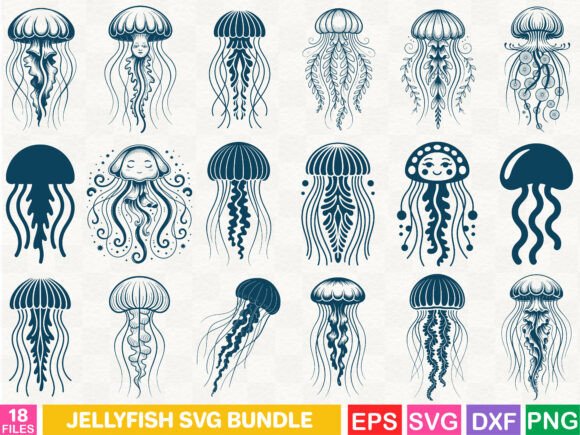
The Jellyfish SVG Bundle lands with quiet confidence—not loud, not overly detailed, but unmistakably alive. The tentacles curve with organic rhythm; the bell has gentle taper and subtle contouring. It’s not cartoonish, nor is it hyper-realistic—it lives in that sweet spot where illustration meets embroidery readiness. As an Illustrations asset, it breathes well: open negative space, balanced weight distribution, and clean vector paths that suggest satin stitch edges and smooth fill transitions. This isn’t a design begging for 12 colors or micro-detail—it’s built for clarity at 3–4 inches wide, which is exactly where most tote bag designs, sweatshirt chest placements, and nursery pillow covers live.
Real Project Test: A Custom Embroidered Tote for a Local Bookstore
Last week, I used the Jellyfish SVG Bundle to create a limited-run tote for a seaside bookstore’s summer launch. Cotton canvas, medium-weight stabilizer, standard 4” hoop. No digitizing—just imported the SVG into my embroidery software, scaled to 3.75”, and ran a quick test on scrap fabric. What stood out immediately: the tentacles didn’t tangle or overfill. The fill stitch laid flat, the satin-stitched bell edge held crisp definition, and the overall density felt breathable—not stiff or plasticky. Customers loved the softness and movement of the finished piece. One even asked, “Did you hand-stitch that?” (No—but it *felt* handmade.) That’s the quiet win: this bundle supports the perception of care, not just convenience.
Where It Shines—and Where to Pause
The Jellyfish SVG Bundle works beautifully on:
- Custom apparel: Sweatshirts, crewnecks, and relaxed tees—especially when placed on left-chest or back yoke for visual balance.
- Baby embroidery: On organic cotton onesies or swaddle blankets, its gentle shape reads as soothing, not busy.
- Embroidered patch production: Clean outlines and minimal internal detail mean sharp cut edges and easy peel-away backing.
- Nursery decor & holiday embroidery: Think pillow covers for ocean-themed nurseries or embroidered ornaments—its fluid lines soften seasonal rigidity.
- Small shop product differentiation: Paired with neutral linen or oatmeal canvas, it elevates a basic tote or apron from “generic” to “curated.”
But here’s where judgment matters: avoid using the Jellyfish SVG Bundle without testing on:
- Stretchy fabric (like jersey knits) unless paired with cutaway stabilizer and reduced stitch density—tentacle tips can distort.
- Dark or textured fabrics without adjusting thread contrast—light pastel threads vanish on charcoal twill; test black-on-navy or navy-on-cream for depth.
- Caps or curved surfaces without re-hooping strategy—the bell’s width may require careful placement to avoid puckering.
- Tiny hoop sizes (<3”)—the delicate tentacle ends lose definition below 2.5” scale.
- Frequently washed items (like kitchen towels) without confirming stitch density—tight fills hold up better than sparse running-stitch interpretations.
Design Integrity Meets Business Reality
As an Etsy seller and small shop owner, I don’t just ask “Does it stitch?” I ask: “Does it sell?” And yes—the Jellyfish SVG Bundle supports buyer trust. Its consistency across products (a matching mug design, a printable mockup, and the same embroidery file) builds brand cohesion without demanding custom artwork for every format. For craft fair shoppers, it feels intentional—not clip-art repurposed. For wholesale buyers, it signals professionalism: no jagged edges, no overlapping paths, no hidden layers that crash embroidery software.
That said—this is a Graphics file, not a pre-digitized machine embroidery design. If you’re new to digitizing, treat it like raw material: inspect anchor points, simplify paths if needed, and always preview stitch direction before finalizing. Don’t assume automatic conversion will honor the flow of those tentacles.
Practical Notes Every Embroidery Designer Should Keep Handy
- Test first—on your exact fabric + stabilizer combo. A jellyfish that floats beautifully on denim may sink into terrycloth.
- Check thread color contrast in natural light—not just on-screen. What looks vivid in RGB can mute on cotton.
- Review stitch density before sending to machine. Overly dense fills on lightweight fabric = stiffness and cracking.
- Confirm hoop size compatibility. If your smallest hoop is 3.5”, scale accordingly—don’t force-fit.
- Inspect small details manually: tentacle tips, bell contours, and negative space between arms should remain legible at target size.
- Test black-and-white mockups—many customers buy embroidery based on line integrity alone.
- Compare light/dark backgrounds visually. Some jellyfish palettes read as “glowing” on darks but “washed out” on lights.
- Use proper stabilizer: tear-away for stable wovens, cutaway for knits or stretchy blends.
- Verify licensing before selling finished products or bundling the SVG with digital kits—this affects your craft business compliance long-term.
The Jellyfish SVG Bundle won’t replace your core digitizing toolkit—but it’s a thoughtful, flexible starting point. It respects fabric. It respects time. And it respects the quiet pride of handing someone a handmade product that *feels* considered, not assembled. Whether you’re stitching a single personalized gift or scaling for your Etsy shop’s next bestseller, this bundle earns its place—not as filler, but as foundation.