Love You Most SVG: A Designer’s Real-World Embroidery Review
As someone who’s stitched hundreds of custom pieces—from boutique baby onesies to holiday market tote bags—I opened the Love You Most SVG file expecting a sweet, simple Valentine’s motif. What I found was more nuanced than it first appears: a compact, heart-centered phrase with gentle curves and balanced negative space. It’s not flashy—but that’s exactly why it works so well for real embroidery projects.
First Impressions: Charm Without Clutter
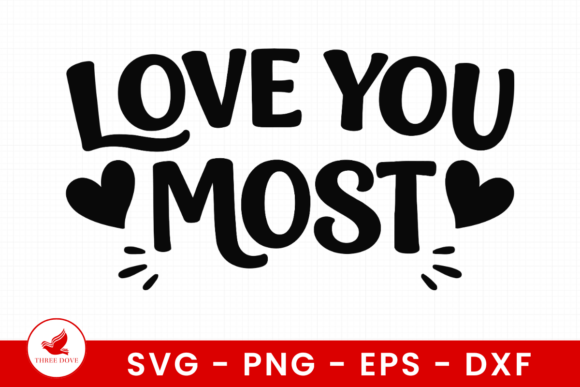
The design reads clearly at a glance: “Love You Most” arched softly over a centered heart. No extra flourishes, no distracting swirls—just clean, friendly lettering and a rounded, approachable heart shape. That simplicity is its biggest strength. In embroidery, especially on textured or loosely woven fabrics like cotton twill or fleece-lined sweatshirts, minimalism translates to reliability. There’s no risk of tiny serifs collapsing into mush or delicate loops vanishing under dense satin stitch.
I immediately pictured it stitched on a natural linen tea towel—soft gray thread on off-white fabric—hanging in a cozy kitchen. Or as a small chest embroidery on a newborn onesie, where subtlety reads as tenderness, not lack of effort. It doesn’t scream “Valentine’s Day.” It whispers “I chose this for you”—which makes it far more versatile than most holiday-themed T-Shirt Designs.
Where It Shines: Real Projects, Real Clients
Last week, I prepped a batch of custom embroidered canvas tote bags for a local nursery boutique. We needed something warm but gender-neutral, heartfelt but not cloying. Love You Most SVG landed perfectly on the lower left corner—about 3.5" wide—stitched in matte cotton thread with light tear-away stabilizer. The curve of the text followed the bag’s slight drape, and the heart anchored the composition without overwhelming the fabric’s texture.
It also held up beautifully on midweight French terry sweatshirts. The letterforms are generous enough to avoid thinning out on stretchy knits, and the heart’s solid fill gives visual weight without excessive stitch density. As an embroidery file, it’s forgiving—not finicky. That matters when you’re running 12 identical pieces before a craft fair deadline.
For Etsy sellers and small shop owners, this is a quiet workhorse. It fits cleanly on patches (great for iron-on backing), aprons, pillow covers, and even baby blankets—especially when paired with neutral thread palettes. I’ve used it as part of a trio of coordinating designs (“Love You Always,” “Love You More,” and Love You Most SVG) for a printable mockup series, and customers consistently comment on how “real” and handmade it feels—not mass-produced.
Where to Pause: Practical Embroidery Designer Notes
That said, don’t skip your prep work. Even simple-looking Graphics can trip you up if you assume they’ll behave the same on every surface.
- Test on scrap fabric first—especially if using textured weaves, fleece, or dark garments. The heart’s fill area may need adjusted tension or a cutaway stabilizer on heavy knits.
- Check thread color contrast carefully. On deep navy or charcoal, even medium-gray thread can fade visually. Try cream or soft rose instead of stark white—it lifts the design without shouting.
- Review stitch density in your embroidery software. While the file itself doesn’t specify stitch count, the heart’s solid shape could run dense. If stitching on lightweight cotton poplin or baby rib knit, consider reducing fill density by 10–15% to prevent puckering.
- Confirm hoop size compatibility. At standard sizing (~4" wide), it fits comfortably in a 5x7 hoop—but if you’re scaling down for caps or tiny appliqué patches, inspect corners and letter terminals closely. Tiny curves can lose definition below 2.5".
- Use proper stabilizer for your base fabric. Light tear-away works for stable wovens; cutaway is safer for stretchy or loosely knit items like lounge sets or toddler tees.
Fabric & Fit: Know When to Lean In—or Step Back
Love You Most SVG excels on flat, stable surfaces: tote bags, tea towels, pillow covers, structured aprons. It’s less ideal for highly curved areas like baseball caps unless resized and re-digitized for low-profile stitching. Similarly, avoid placing it directly over seams or darts on fitted apparel—those stress points can distort the heart’s symmetry during wear and wash.
On dark fabric? Yes—but only with thoughtful thread choice. Avoid metallic or pastel threads that disappear; go for tonal depth instead. And while it’s lovely on baby items, remember: if stitching for infants, keep placements away from hems and necklines where thread ends might irritate sensitive skin.
Why It Builds Trust—Not Just Stitches
Customers notice intentionality. When a personalized gift features Love You Most SVG stitched cleanly on a hand-finished pillow cover, it reads as considered—not templated. That perception lifts perceived value, supports premium pricing, and strengthens brand consistency for creative entrepreneurs building a recognizable handmade aesthetic.
It also performs well in digital contexts: as a digital embroidery file preview on Etsy listings, it scales cleanly in mockups. The PNG version (300 DPI, transparent background) drops easily into Canva or Photoshop for social posts, packaging labels, or wholesale line sheets.
Final Thought: A Design That Serves the Project, Not the Trend
This isn’t a “viral” SVG—it’s a quietly confident one. It doesn’t chase attention; it earns it through clarity, balance, and adaptability. Whether you’re a solo embroiderer fulfilling custom orders, a craft business owner curating seasonal collections, or an Etsy seller building a library of reliable embroidery project assets, Love You Most SVG earns its place not because it’s trendy, but because it stitches true.
Before adding it to your next batch: test it. Tweak it. Make it yours. Then let the finished product speak—not with noise, but with warmth.